



Share this page

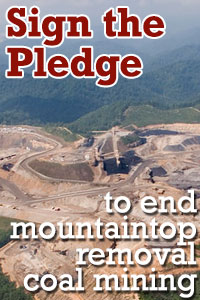
108,246 people have already pledged to help end mountaintop removal.
Add your voice!


Tell me more

Write to Congress
Watch America's Most Endangered Mountain Videos
What's My Connection?
Bloggers Challenge
Go Tell It on the Mountain
The High Cost of Coal
Please Donate


Mountaintop Removal News RSS Feed - by iLoveMountains.org

↑ Grab this Headline Animator

News


Clean Water Protection Act Introduced with 45 Cosponsors

Tuesday, May 7th, 2013

Yesterday, Rep. Frank Pallone (D-NJ) and Rep. Dave Reichert (R-WA) introduced the Clean Water Protection Act in the 113th Congress with 45 original cosponsors.

The Clean Water Protection Act, H.R. 1837, is a bill in the U.S. House of Representatives which would sharply reduce mountaintop removal coal mining by making it illegal to dump mining waste into valleys and streams. To date, more than 2,000 miles of streams have been buried or severely polluted.

As the bill sponsors point out in their Dear Colleague letter to other members of Congress:

An EPA scientific study in 2008 shows that more than 63% of the streams sampled below mountaintop removal coal mining operations exhibited long-term impairments to aquatic organisms. In some large watersheds, more than half of the streams are impaired.

Last Congress, more than 130 representatives, from Kentucky to Hawaii, took a stand against mountaintop removal coal mining by cosponsoring the Clean Water Protection Act.

It is crucial that we carry over the momentum we built during the last Congress by having a large group of cosponsors. For your Representative to sign onto the bill, they need to hear from you.

Take action now and tell your Congressperson you expect their support of this important legislation.


Teri Blanton Recognized as Female Leader in Environmental Movement

Tuesday, April 30th, 2013

Kentucky native Teri Blanton was recognized as a leader in the environmental movement at the second annual White House Women and the Environment Summit.

Teri Blanton, native of Harlan, Ky., was recently honored by the White House as one of 100 female leaders in the environmental movement during their second annual White House Women and the Environment Summit.

If you know Teri, it’s no surprise that she would be given such an honor. She has worked tirelessly to educate Kentuckians and mountain people across Appalachia about the adverse effects of living in communities impacted by coal mining.

As a Fellow for Kentuckians for the Commonwealth and a representative of The Alliance For Appalachia, she concentrates her efforts on campaigns to protect the health of the people, the water and the air by putting an end to mountaintop removal mining in eastern Kentucky, programs to educate communities about contamination of local waterways with deadly heavy metals, and initiatives that will create a sustainable energy future for Appalachia.

Teri Blanton speaking at a rally led by Kentuckians for the Commonwealth.

She has spent countless hours in Washington, D.C., and Frankfort, Ky., educating lawmakers on the impacts of mountaintop removal and has traveled across the country raising awareness to new audiences. But one can only lobby the same office so many times before growing frustrated by the lack of progress.

In 2009, Teri traveled to D.C. and participated in the Capitol Climate Action alongside 5,000 others who were outraged at our countries continued reliance on coal and other fossil fuels. The next year she was arrested in front of the White House during Appalachia Rising, alongside 121 others to demand an end to mountaintop removal. She even moved into the Governor’s Mansion for a four-day occupation in 2011 with 13 other Kentuckians after being denied a meeting with Governor Beshear on the issue.

But for Teri, the injustices don’t stop within the hills and hollers of Appalachia, she is a vocal proponent of collaboration across all communities impacted by the extraction, transport, burning and disposal of dirty, polluting fossil fuels.

At the summit, Teri and other female leaders met with with senior White House and U.S. Environmental Protection Agency officials. The discussion focused on the importance of women and their role in protecting public health and the environment.

Teri will be returning to D.C. next week, along with people from across the country, for the 8th Annual End Mountaintop Removal Week in Washington, and will be requesting meetings with many of the same top White House and EPA officials, we will see if they have taken her message to heart by then.


Leave “Act of God” claims at the door: OSM study finds Coal dams fail compaction tests

Thursday, April 25th, 2013

A draft report prepared by the Office of Surface Mining Reclamation and Enforcement found that many of the massive slurry impoundments in Appalachia do not pass muster. Focused on the compaction of coal waste embankments, the report’s findings speak volumes — “of 73 field density tests performed at seven sites, only 16 yielded passing results.” In the past, some have been quick to call slurry spills and impoundment breakthroughs “Acts of God.” In light of this report and past research, the effect of that tactic should be entirely eroded.

Thanks Sludge Safety Project and Coal River Mountain Watch , who shared the draft report, the clear and present danger of slurry impoundments in Appalachia is being reported on widely in major regional and national papers.

From The Washington Post this morning:

Many of the man-made ponds for storing toxic sludge from coal mining operations have dangerously weak walls because of poor construction methods, according to the synopsis of a study for the Office of Surface Mining Reclamation and Enforcement obtained by The Washington Post.

Tests of the density of these impoundment walls showed flaws at all seven sites surveyed in West Virginia, with only 16 field tests meeting the standards out of 73 conducted, the 2011 report says.

Slurry, also known as coarse coal refuse, is what is left over once companies wash coal to enable it to burn more efficiently. Coal firms have disposed of this combination of solids and water in a few different ways: damming it in large ponds, depositing it in abandoned mines and using a dry filter-press process to compact it.

The Interior Department’s mining agency ordered the survey — which is in draft form and has not been publicly released — after its engineers noticed that companies were using coarse refuse that will not stay compacted except “within a narrow range” of moisture conditions, according to the synopsis. The conditions were not monitored and bulldozers were used to compact the soil, a task for which they are poorly suited, it added.

Chris Holmes, a spokesman for the agency, said it was examining a “potential issue” with compaction of dams but that it “has not found any indication that any coal slurry impoundment is in imminent danger of failure. Had it done so, OSM would have taken action immediately.”

There are 596 coal slurry impoundments in 21 states, according to the Mine Safety and Health Administration, of which the largest number, 114, are in West Virginia.

From time to time, one of these slurry ponds breaks, posing a threat to both worker safety and the environment. A worker operating a bulldozer was killed in November when an embankment collapsed at Consol Energy’s Robinson Run mine in West Virginia.

In a much bigger spill back in 2000, slurry gushed out of holding pond owned by Massey Energy in Martin County, Ky., into an abandoned mine. That accident contaminated the water supply of more than a dozen communities and killed aquatic life in local waterways.

Jack Spadaro, an engineering consultant and former director of the National Mine Health and Safety Academy, said the analysis underscores the inherent problem in how mining companies store the waste from their operations.

“It’s a very weak material and when it’s wet, it’s even weaker,” Spadaro said in an interview, adding that while there are regulations aimed at preventing accidents, “the problem is the agencies in charge of enforcing them are not enforcing them.”

National Mining Association spokesman Luke Popovich wrote in an e-mail that the Office of Surface Mining had done a more recent report on impoundments concluding that those near underground mines posed “a minimal risk,” but the agency “nevertheless urged state agencies and mines to ensure their maps of [underground] mines in the vicinity of impoundments are accurate.”

“We were not riled up by nor objected to anything in this report,” he wrote, referring to the 2011 survey of West Virginia impoundments.


A Good Week for Mountains – Multiple Court Rulings Favor Science and Enforcement

Tuesday, April 23rd, 2013

We’re only two days into Earth Week — if we must limit it to one week out of the year — but it sure is getting off to a great start. Two major court rulings over the past two days underscore the need for increased scrutiny from the federal agency responsible for evaluating environmental impacts of mountaintop removal coal mining according to the National Environmental Policy Act and issuing permits under the Clean Water Act.

Yesterday, the 6th U.S. Court of Appeals revoked the U.S. Army Corps of Engineers use of Nationwide Permit 21 (NWP 21), a streamlined and inadequate process that has contributed to the expansion of mountaintop removal in Appalachia since 1992.

In its ruling, the three-judge panel called the Corps’ actions “arbitrary and capricious” and found that the agency did not follow the applicable Clean Water Act (CWA) and National Environmental Policy Act (NEPA) regulations, which require it to document its assessment of environmental impacts and examine past impacts before issuing new permits. From the ruling:

Though we generally give greatest deference to an agency’s “complex scientific determination[s] within its area of special expertise,” we may not excuse an agency’s failure to follow the procedures required by duly promulgated regulations.

After opting for streamlined nationwide permitting, the Corps took the easier path of preparing an environmental assessment instead of an environmental impact statement. Having done so, it needed to follow the applicable CWA and NEPA regulations by documenting its assessment of environmental impacts and examining past impacts, respectively. Failing these regulatory prerequisites, the Corps leaves us with nothing more than its say-so that it meets CWA and NEPA standards.

According to the Corps, approximately 70 surface mining permits authorized under NWP 21 qualify for a five-year accommodation to “provide and equitable and less burdensome transition” for coal operators. Whatever its impact on existing mountaintop removal permits, the ruling acknowledges that when it comes to protecting Appalachia, the Corps “say-so” is insufficient.

This morning, as word of yesterday’s win for the mountains continued to spread, the U.S. Court of Appeals for the District of Columbia reversed a ruling that overturned the U.S. Environmental Protection Agency’s veto of the Spruce Mine surface mine permit — one of the largest mountaintop removal mines in history.

Earthjustice, which along with Appalachian Mountain Advocates, represented West Virginia Highlands Conservancy, Ohio Valley Environmental Coalition, Coal River Mountain Watch, Sierra Club, and Natural Resources Defense Council as friends of the court, called the ruling a major blow to the coal industry’s attempt to prevent EPA from protecting communities from the harm caused by mountaintop removal mining in Appalachia.

While an earlier ruling called EPA’s interpretation of Section 404 of the Clean Water Act “magical thinking,” today’s announcement reaffirms the EPA’s role in the permitting process. In her ruling, Circuit Judge Karen LeCraft Henderson, concluded that:


… The Congress made plain its intent to grant the Administrator authority to prohibit/deny/restrict/withdraw a specification at any time … Thus, the unambiguous language of subsection 404(c) manifests the Congress’s intent to confer on EPA a broad veto power extending beyond the permit issuance.

These rulings come as research supporting the irreversible damage done by valley fills which have been found to irreversibly damage water quality and the once-abundant aquatic life of many Appalachian streams.

“Today’s decision upholds essential protection for all Americans granted by the Clean Water Act,” said Emma Cheuse, an attorney for Earthjustice. “Communities in Appalachia can finally breathe a sigh of relief knowing that EPA always has the final say to stop devastating permits for mountaintop removal mining. Now, we just need EPA to take action to protect more communities and mountain streams before they are gone for good.”

It has been a good few days for mountains, and the communities of Appalachia. We congratulate and thank our allies — especially Earthjustice, Appalachian Mountain Advocates, West Virginia Highlands Conservancy, the Sierra Club, Coal River Mountain Watch, the Ohio Valley Environmental Coalition, and Natural Resources Defense Council — for their dedication and hard work through years of litigation. Our Earth Week, and the weeks ahead, are brighter for it.


Welcome Interior Secretary Sally Jewell, Tell Her to Protect Appalachia from Mountaintop Removal

Thursday, April 18th, 2013

This week, Sally Jewell became the Obama Administration’s Secretary of the Department of the Interior. Jewell is now in a key position to halt the damaging environmental and health effects of mountaintop removal coal mining. But in order to make sure that it is a top priority issue, she needs to hear from you right away.

Take action now and tell Secretary Jewell know that we need her leadership.

During President Obama’s first term, the administration promised to restore longstanding stream protections to Appalachia. Despite this assurance, progress has been slow and Appalachian streams remain threatened.

Secretary Jewell has the ability to take immediate action and direct the Office of Surface Mining Reclamation and Enforcement to issue a long-overdue rule to prevent the dumping of coal mining waste into streams. We need Jewell to ensure that a strong standard is created and that it is fully implemented in Appalachia.

Contact Secretary Jewell today.

The day before her confirmation, President Obama said that Jewell had an “appreciation for our nation’s tradition of protecting our public lands and heritage, and a keen understanding of what it means to be good stewards of our natural resources.” We are encouraged by this and expect that she will stand up for the heritage and well being of the Appalachian region.


Lend Your Voice: Tell EPA It has the Key to Protect Appalachia

Monday, April 15th, 2013


Tell the EPA to protect water quality and community health.

Two months ago we worked together to generate thousands of comments to U.S. Environmental Protection Agency demanding that they use sound science to create a water quality standard that will protect the health and water of Appalachians.

Today, Appalachians are joining with national allies to take this message straight to regional EPA offices in Philadelphia and Atlanta. You can join them by lending your voice.

Call your EPA office today. Let them know that Appalachia is locked to dirty water and that EPA holds the key to a healthy and brighter future for our region.

Before the blasting begins, and long after the blasting stops, mountaintop removal poisons water in Appalachian communities. We need EPA to act on its own science and issue a legally binding water quality standard on conductivity to protect streams and communities in Appalachia from mountaintop removal mining pollution.

Will you join these Appalachians gathered in Philadelphia and Atlanta today? Can you lend your voice?


URGENT: Tell Gov. Tomblin to Block the Expansion of Brushy Fork

Monday, March 25th, 2013

http://on.fb.me/Z7bBg2We just got the word that MSHA has approved a 50 foot and 2 billion gallon expansion to the 750 foot tall and 6.6 billion gallon Brushy Fork coal slurry dam.  Unless the West Virginia Department of Environmental Protection (WVDEP) denies the expansion, the largest sludge impoundment in Appalachia will become taller than the Hoover Dam.  WVDEP and the Federal Office of Surface Mining have been studying the compaction of coal waste dams in WV for the past two years.

Take action now and call Gov. Tomblin at (304) 558-2000. Demand that he order a halt to expansion to Brushy Fork impoundment until they complete the compaction study. 

Regulators continue to rely on company-submitted data to prove that impoundments are properly constructed.  This is unacceptable given that the same engineers are responsible for the design of this dam as the the disastrous 2000 Martin Co., KY sludge spill and were overseen by the Massey engineering team responsible for the Upper Big Branch disaster. Citizens deserve to know if the existing impoundment is truly safe before this massive dam gets larger.

Please share this image on Facebook to help spread the word!


Tennessee Game Changer: Conservative Union Running Pro-Mountain Ads Statewide

Tuesday, March 19th, 2013

Conservative Ad Buy Turning Scenic Vistas Bill into Bipartisan Bombshell

When it comes to Tennessee, most everybody has their reason for supporting our mountains. Whether it is a liberal urban Democrat like Representative Steve Cohen (D-TN), or a mainline Republican like Senator Lamar Alexander (R-TN), its not a complicated equation.

Now, it turns out, a radically right-wing group in Tennessee – the Tennessee Conservatives Union – has not only come out in support of the Tennessee Scenic Vistas Protection Act, but is planning to run statewide television ads in support of protecting Tennessee’s mountains. This is astounding, to say the least. The Conservatives Union is no small player in Tennessee politics, calling itself the oldest and largest conservative organization in the state. With more than 12,000 members, they are widely credited for defeating the state income tax, among other things. Now they are looking to protect our mountains from, allegedly, a Chinese company that has bought out mineral rights in Tennessee.

Appalachian Voices doesn’t necessarily agree with every sentiment in this advertisement. It doesn’t matter if somebody is from Beijing or Bristol, we don’t think they should be blowing up mountains. We certainly don’t agree with the Conservatives Union on many important issues related to energy and the environment, but the fact that the Tennessee Conservatives Union is stepping up to stop mountaintop removal shows that the breadth of support for protecting Tennessee’s mountains ranges all the way from left-to-right, odd-to-even, and low-to-high.

According to the TN Conservatives Union, this ad will begin airing tomorrow (3/19) on Fox News.

Now is the time for you to pick up the phone and call Committee Members to tell them YOUR reason for supporting the bipartisan Scenic Vistas Protection Act (SB 99/HB 43). The Senate Energy, Agriculture, and Natural Resources Committee will take up the bill first at 9:30 AM on Wednesday. The House Subcommittee on Agriculture and Natural Resources is scheduled to vote at 1:30 the same day.

These committee offices have told us that they are hearing from a LOT of people who are working to protect our mountains, so keep up those calls! Talking points below…

Senate Committee Members:
Chairman Steve Southerland (R-Morristown)/615-741-3851
Mae Beavers (R-Mt Juliet)/ 615-741-2421
Jim Summerville (R-Dickson) / 615-741-4499
Mike Bell (R-Riceville) / 615-741-1946
Charlotte Burks (D-Monterey) / 615-741-3978
Ophelia Ford (D-Memphis) / 615-741-1767
Todd Gardenhire (R-Chattanooga) / 615-741-6682
Dolores Gresham (R-Somerville) / 615-741-2368
Frank Niceley (R-Knoxville) / 615-741-2061

House Committee Members:
Chairman Ron Lollar (R-Bartlett) / 615-741- 7084
Curtis Halford (R-Dyer) / 615-741-7478
Andy Holt (R-Dresden) / 615-741-7847
Judd Matheny (R-Tullahoma) / 615-741-7448
Billy Spivey (R-Franklin) / 615-741-4170
John Tidwell (D-New Johnsonville) / 615-741-7098
Ron Travis (R-Dayton) / 615-741-1450
Brenda Gilmore (D-Nashville) / 615-741-1997 [This is a “Thank you!” as Representative Gilmore is a cosponsor of the Scenic Vistas bill.]

Please pass this along, so that legislators hear from as many Tennesseans as possible. Talking points and bill information below…
(more…)


URGENT: Tennessee Votes on the Scenic Vistas Protection Act Tomorrow. Call Today!

Tuesday, March 12th, 2013

Call today. Tell your committee members to support the Scenic Vistas Protection Act tomorrow.

Tennessee legislators are scheduled to take up a critical vote tomorrow on the Scenic Vistas Protection Act a bill with broad, bipartisan support that would help ensure the beauty and economic vitality of the Cumberland Plateau.

Call your legislators today and ask them to support the Scenic Vistas Protection Act.

Representative Gloria Johnson (D-Knoxville) will be carrying the bill (HB 43 / SB 99) in the House Subcommittee on Agriculture and Natural Resources, and Senator Lowe Finney (D-Jackson) in the Senate Committee on Energy, Agriculture, and Natural Resources.

Here are a list of critical legislators who need to hear from you before tomorrow’s vote:

House:

Chairman Ron Lollar (R-Bartlett) / 615-741- 7084

Curtis Halford (R-Dyer) / 615-741-7478

Andy Holt (R-Dresden) / 615-741-7847

Judd Matheny (R-Tullahoma) / 615-741-7448

Billy Spivey (R-Franklin) / 615-741-4170

John Tidwell (D-New Johnsonville) / 615-741-7098

Ron Travis (R-Dayton) / 615-741-1450

Brenda Gilmore (D-Nashville) /  615-741-1997 [This is a “Thank you!” as Representative Gilmore is a co-sponsor of the Scenic Vistas bill.]

Senate:

Chairman Steve Southerland (R-Morristown)/615-741-3851

Mae Beavers (R-Mt Juliet)/ 615-741-2421

Jim Summerville (R-Dickson) / 615-741-4499

Mike Bell (R-Riceville) / 615-741-1946

Charlotte Burks (D-Monterey) / 615-741-3978

Ophelia Ford (D-Memphis) / 615-741-1767

Todd Gardenhire (R-Chattanooga) / 615-741-6682

Dolores Gresham (R-Somerville) / 615-741-2368

Frank Niceley (R-Knoxville) / 615-741-2061

Let these legislators know that you are a Tennessean who cares about protecting our mountains. And please pass this along so that legislators hear from as many of us as possible.

What does this bill do?

The Scenic Vistas Protection Act says that you can’t blast apart virgin ridgelines above 2,000 feet when surface mining for coal.

What does this bill NOT do?

  • Scenic Vistas DOES NOT impact underground mining or other important industries in Tennessee.
  • Scenic Vistas DOES NOT Impact any current surface mining permits or their renewals, which are grandfathered in.

A few talking points

  • As Tennesseans, we love our mountains, and we don’t think we need to blast them apart for a small amount of coal.


  • We don’t have to hate coal and we don’t have to hate coal mining to want to protect our mountains. We just want Tennessee to be the first state to say “We’re going to mine coal AND protect our mountaintops at the same time.”


  • Since 1985, the Tennessee coal industry has laid off 85 percent of its workforce, while the percentage of our coal coming from surface mining versus underground mining has increased. Scenic Vistas will help protect coal-mining jobs in our state.


  • Mountaintop removal is bad business, and even the coal industry is realizing that this destructive form of mining is not worth the cost. Patriot Coal, one of the largest coal companies in the nation, recently announced that it is stopping mountaintop removal operations because not only is it damaging to the environment, but it’s bad for their employees and for the communities where they work.

After you make your calls, e-mail us at tn@appvoices.org to let us know what the offices are saying!


Former Massey Official Pleads Guilty, Says He Conspired with CEO

Friday, March 1st, 2013

Ken Ward Jr. of the Charleston Gazette wrote yesterday that David C. Hughart, a former Massey official, pleaded guilty to conspiring to defraud the government by thwarting U.S. Mine Safety and Health Administration inspections. Hughart has agreed to cooperate with authorities in the ongoing criminal investigation of the Upper Big Branch mine disaster and yesterday in court stated he conspired with Don Blankenship, implicating the former CEO a decade of avoiding safety laws at several mines.

From the Gazette:

A fairly routine plea hearing here took a surprising twist when U.S. District Judge Irene Berger pressed Hughart to name his co-conspirators and Hughart responded, “the chief executive officer.”

Hughart did not use Blankenship’s name, but Blankenship was CEO of Massey from 2000 until 2010, during the period when the crimes Hughart admitted to committing occurred.

In a nearly three-year investigation that started with the deaths of 29 miners in the Upper Big Branch Mine Disaster and has so far prompted four convictions, the accusation by Hughart is the first courtroom statement to specifically allege any wrongdoing by Blankenship.

William Taylor, a lawyer for Blankenship, said his client has done nothing wrong and downplayed the significance of what Hughart said.

“We were quite surprised at the reports of Mr. Hughart’s statements at the time of his guilty plea,” Taylor said. “Don Blankenship did not conspire with anybody to do anything illegal or improper. To the contrary, he did everything he could to make Massey’s mines safe.

“We’re not concerned particularly about the story concerning Mr. Hughart,” Taylor said. “It’s not surprising that people say untrue things when they are trying to reduce a possible prison sentence.”

When he’s sentenced on June 25, Hughart, 54, of Crab Orchard, faces up to six years in prison and a fine of up to $350,000. In a deal with prosecutors, Hughart pleaded guilty to one felony count of conspiracy to defraud the government by thwarting U.S. Mine Safety and Health Administration inspections and one misdemeanor count of conspiracy to violate MSHA safety standards. Hughart also agreed to cooperate with authorities in the ongoing criminal investigation of the mine disaster and broader questions about Massey safety practices.

“Guilty of both charges,” Hughart told Berger when the judge asked him to enter his formal plea.

Hughart did not work at Upper Big Branch, and his plea deal involved crimes he has admitted committing between 2000 and 2010 at Massey’s White Buck operations in Nicholas County, where two mid-level foremen and a Massey operating subsidiary were prosecuted five years ago for criminal safety violations.

Prosecutors identified Hughart as having served as president of Massey’s Green Valley “resource group,” which included White Buck. But Hughart also worked for Massey for more than 20 years, serving as an officer or a director at more than two-dozen subsidiaries, according to public records.

Hughart was fired in March 2010, and internal Massey records, filed in a circuit court case, allege he had failed a random drug test and received kickbacks from a Massey contractor.

In court documents in Hughart’s case, prosecutors alleged a broader conspiracy by unnamed “directors, officers, and agents” of Massey operating companies to put coal production ahead of worker safety and health at “other coal mines owned by Massey.” Those documents, filed in late November, were the first time in their Upper Big Branch probe that prosecutors have formally alleged Massey officials engaged in a scheme that went beyond the Raleigh County mine that exploded on April 5, 2010, and killed 29 workers.


Appalachian Voices  •  Coal River Mountain Watch  •   Heartwood  •  Keeper of the MountainsKentuckians for the Commonwealth 

Ohio Valley Environmental Coalition  •   Statewide Organizing for Community eMpowermentSierra Club Environmental Justice

Southern Appalachian Mountain Stewards  •   SouthWings  •  Stay Project  •   West Virginia Highlands Conservancy

Buy stickers, shirts, hats, and more...

Site produced by Appalachian Voices 171 Grand Blvd, Boone, NC 28607 ~ 1-877-APP-VOICE (277-8642) ~ ilm-webmaster@ilovemountains.org